
You have a board meeting in Dallas. Your flight from Houston takes 55 minutes. You are already calculating the math in your head, thinking it makes sense to fly.
It does not. And if you have ever done the route before, you already know this somewhere in the back of your mind — even if you keep booking the flight out of habit.
For trips under 300 miles, the case for luxury ground transportation is not just competitive with flying. In most real-world scenarios, door-to-door, it is faster. It is certainly more comfortable, more productive, and considerably less stressful. Here is why.
The Math Nobody Does
When most people say “the flight is only an hour,” they are counting gate-to-gate time. That is not the time that comes out of your day. Here is what actually comes out of your day on a short-haul flight:
- Drive to the airport: 20–45 minutes (depending on your location and traffic)
- Parking or rideshare drop-off and terminal entry: 5–15 minutes
- TSA security: 15–40 minutes (longer during peak travel periods)
- Boarding buffer — airlines recommend arriving 90 minutes before domestic departure
- Flight: 55 minutes gate-to-gate
- Deplaning, baggage claim (if you checked a bag): 15–30 minutes
- Car rental desk or rideshare wait at the destination: 10–30 minutes
- Drive from destination airport to your actual meeting location: 20–45 minutes
Add it up and a “55-minute flight” from Houston to Dallas consumes 3.5 to 5 hours of your day — from the moment you leave your door to the moment you walk into your meeting.
Now compare that to a direct luxury car ride on the same route: approximately 3.5 to 4 hours, door to door. You leave from your exact address. You arrive at your exact destination. No parking, no security, no baggage claim, no rental car counter, no rideshare uncertainty at the other end.
The math changes — and not in the way most people expect.
The Routes Where Ground Wins Every Time
Not every route is a candidate for ground travel. A flight from Houston to New York makes obvious sense. But there is a category of short-haul routes — under 300 miles — where luxury ground transportation consistently outperforms flying once you account for the full time cost of the journey. Here are the routes we serve where clients make this switch every day:
Houston to Dallas — 240 Miles
This is the most-traveled business corridor in Texas and arguably the clearest case for ground travel in the country. The drive is approximately 3.5 to 4 hours. The “flight” — accounting for both airports and everything that surrounds them — is rarely less than 3.5 hours total. Our Houston-to-Dallas clients consistently report that they arrive no later by car than they would have by plane — and they arrive having worked the entire way, in a quiet private cabin, without ever standing in a security line.
Dallas to Austin — 195 Miles
A 2.5 to 3 hour drive. The flight itself is barely 40 minutes, which means the airport experience on both ends constitutes the overwhelming majority of the journey time. This is the route where the math is most dramatically in favor of ground travel.
Houston to Austin — 165 Miles
Approximately 2.5 hours by car, direct. Used heavily by the technology and legal sectors moving between Austin’s growing tech ecosystem and Houston’s energy and financial corridor.
Miami to Orlando — 235 Miles
The I-4 and Florida Turnpike corridor connects two of Florida’s major business centers. The drive is approximately 3.5 hours. But unlike a highway commute in your own car, a luxury vehicle means you are working, resting, or taking calls the entire way — not navigating traffic.
Nashville to Memphis — 210 Miles
Tennessee’s two major markets, roughly 3 hours apart by car. Particularly popular with healthcare executives, music industry professionals, and logistics companies who travel this corridor regularly.
Charlotte to Raleigh — 170 Miles
Finance, banking, and technology professionals moving between Charlotte’s banking capital and the Research Triangle’s technology and pharmaceutical ecosystem. Approximately 2.5 hours by car.
The Productivity Argument
Here is what nobody talks about when they compare flying and driving: what you can actually do during the journey.
On a short-haul flight, the answer is almost nothing useful. You spend the first 20 minutes on the ground taxiing. You are told to keep your seat belt fastened. The cabin is loud, the seats are cramped, and by the time you reach cruising altitude and open your laptop, the descent has already begun. You land exhausted from the overhead bin struggle, the middle seat stranger, and the recycled air.
In a luxury vehicle with The Executive Chauffeurs, the entire journey is productive time. A private, whisper-quiet cabin. Wi-Fi in every vehicle. Climate controlled to your preference. No one beside you. No announcements. No turbulence. You can take calls you would never take on a plane, review documents, prepare for the meeting ahead, or simply rest properly.
Many of our corporate clients tell us the same thing: they arrive at ground-travel meetings more prepared and more composed than at meetings they flew to. The car is not dead time. It is office time — on your terms.
The Cost of Flying That Rarely Gets Counted
Business travel costs are almost always measured in ticket price and hotel. The less visible costs are rarely tallied:
- Parking at the airport: $25–$50 per day at major airports, or the cost of a rideshare both ways
- Checked baggage fees
- Rental car at the destination: $75–$150 per day plus insurance, fuel, and the time spent at the rental counter
- The energy cost of travel stress — the mental tax of airport logistics that affects your performance in the meeting at the other end
- Flight delays and cancellations — which on short-haul routes are disproportionately common, given that regional aircraft and routes are first to be affected by weather and operational disruptions
When you add these costs to the price of a short-haul round trip, a direct luxury car service often compares more favorably than the headline ticket price suggests.
What Luxury Ground Travel Actually Looks Like
For those who have only experienced ground travel as a rideshare or taxi, it is worth being specific about what a luxury intercity ride with The Executive Chauffeurs actually involves.
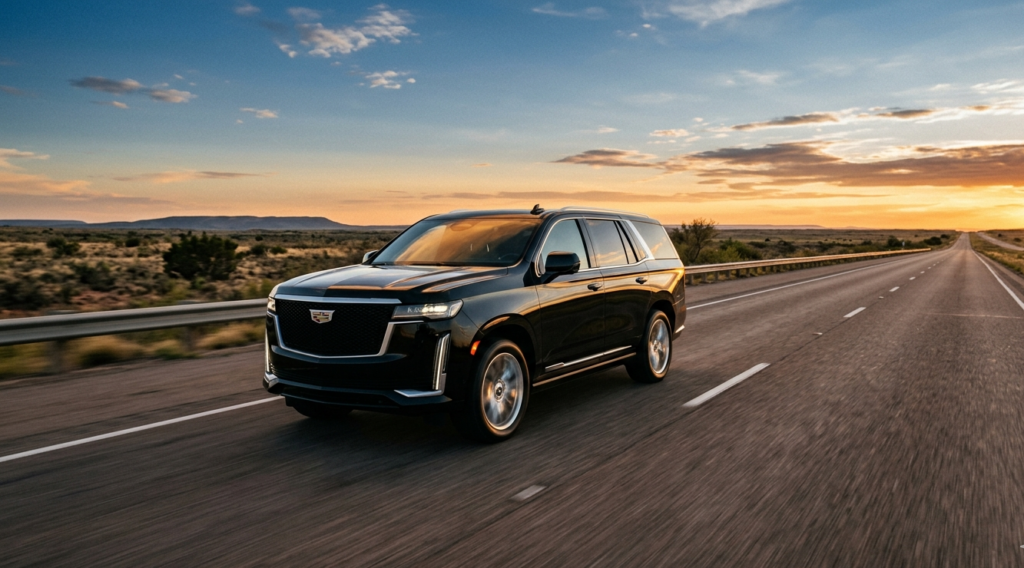
Your chauffeur arrives at your door — your home, office, or hotel — at the scheduled time. Your luggage is handled. The vehicle is a 2025 or 2026 model luxury automobile: a Mercedes S-Class, Cadillac Escalade, Lincoln Navigator, BMW 7 Series, or similar. The interior is immaculate. The temperature is set. Wi-Fi is available.
For the duration of the journey, you are in a private environment. No strangers. No announcements. No performance theater of airline hospitality. Just a composed, professional chauffeur navigating the route while you do whatever the next few hours require of you.
At the other end, you step out at your exact destination. Not at an airport six miles from the city center. Not at a rental car lot. At the front door of the building where your meeting is.
That is what the comparison should actually be.
When Flying Still Makes Sense
This is not an argument that flying is always wrong. For trips over 300 miles — Houston to New York, Dallas to Los Angeles, Miami to Chicago — the time savings of flying become real and meaningful. Ground travel for those distances would consume an entire working day or more.
But for the category of short-haul business travel that fills most executive schedules — the Texas Triangle routes, the Florida corridor, the Southeast state capitals — the honest calculation almost always favors ground. The executives who make the switch rarely go back.
The Decision Framework
Here is a simple way to think about it before your next short-haul trip:
- Under 150 miles: Drive. Every time. The flight experience is almost entirely airport, almost entirely not the destination.
- 150 to 300 miles: Compare honestly, accounting for full door-to-door time and what you can do productively during each option.
- Over 300 miles: Fly. The time savings become real at this distance.
The clients who have made the switch to luxury ground travel on their short-haul routes tell us a consistent version of the same story: they did not realize how much time, energy, and composure they were giving away to airports until they stopped giving it away.
Book Your Next Short-Haul Route
The Executive Chauffeurs provides direct luxury intercity rides across our U.S. network — including Houston to Dallas, Dallas to Austin, Houston to Austin, Miami to Orlando, Nashville to Memphis, Charlotte to Raleigh, and any city-to-city route within our 20+ city footprint.
All rides are in late-model luxury vehicles, driven by professionally trained chauffeurs, with Wi-Fi included and fixed pricing quoted at booking.
To book your next intercity ride or discuss a recurring route for your travel program, call us at 1-800-832-6701 or book online at theexecutivechauffeurs.com/book. We are available 24 hours a day.